Two bottles on a counter
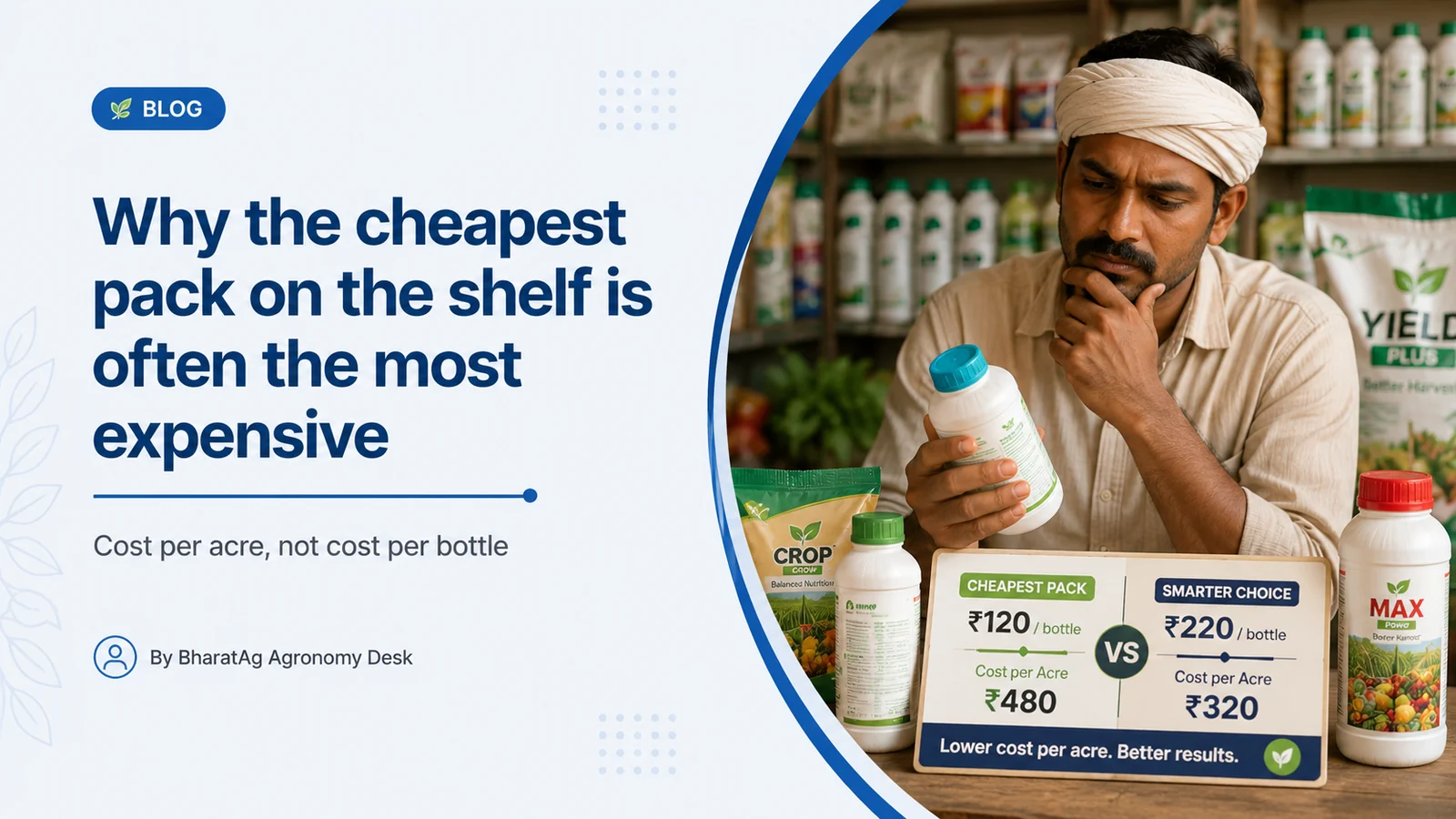
One is ₹400. One is ₹700. The ₹400 one goes home.
But price per bottle is not the number that matters. Three others decide the real cost.
One: how many acres does the bottle cover?
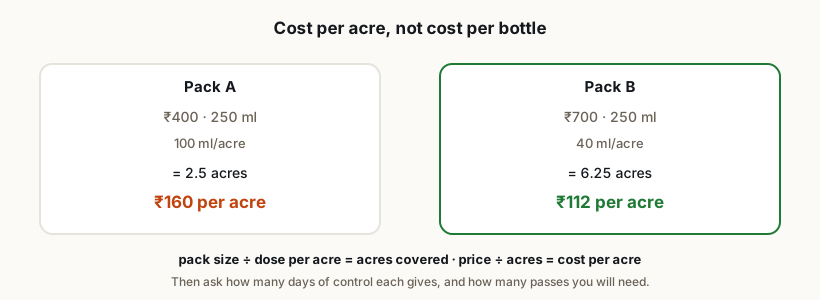
A 250 ml pack at 100 ml per acre covers two and a half acres. A 250 ml pack at 40 ml per acre covers six. The second is more expensive on the shelf and considerably cheaper in the field.
Work it out in front of the dealer: pack size ÷ dose per acre = acres covered. Then price ÷ acres = cost per acre. That is the only comparison worth making.
Two: how many sprays will it take?
A product that gives ten to twelve days of control is not comparable to one that gives four. If the cheap one needs three passes to do what the other does in one, you have paid for two extra tanks, two extra days of labour, and two extra rounds of trampling through a flowering crop.
The labour is usually the bigger number, and it is the one left out of the calculation.
Three: what does it cost if it does not work?
This is the number nobody wants to put on paper, and it is the largest one. A failed spray during a pest window does not cost you the price of the spray. It costs you the fraction of the crop the pest took while you thought the problem was handled.
Where cheap is genuinely cheap
None of this means the expensive product always wins. For a low pest load early in the season, a straightforward, well-established, inexpensive chemistry is often exactly right, and reaching for a premium combination is a waste. The point is not to spend more. It is to compare properly.
The arithmetic at the counter
Ask for four numbers and write them down:
- Dose per acre
- Pack size
- Price
- Expected days of control
Then do the division. A dealer who cannot give you those four numbers for a product he is recommending has not read the label either.
Dose and waiting period are on the label. Any figure that is not printed on the pack is somebody's opinion.