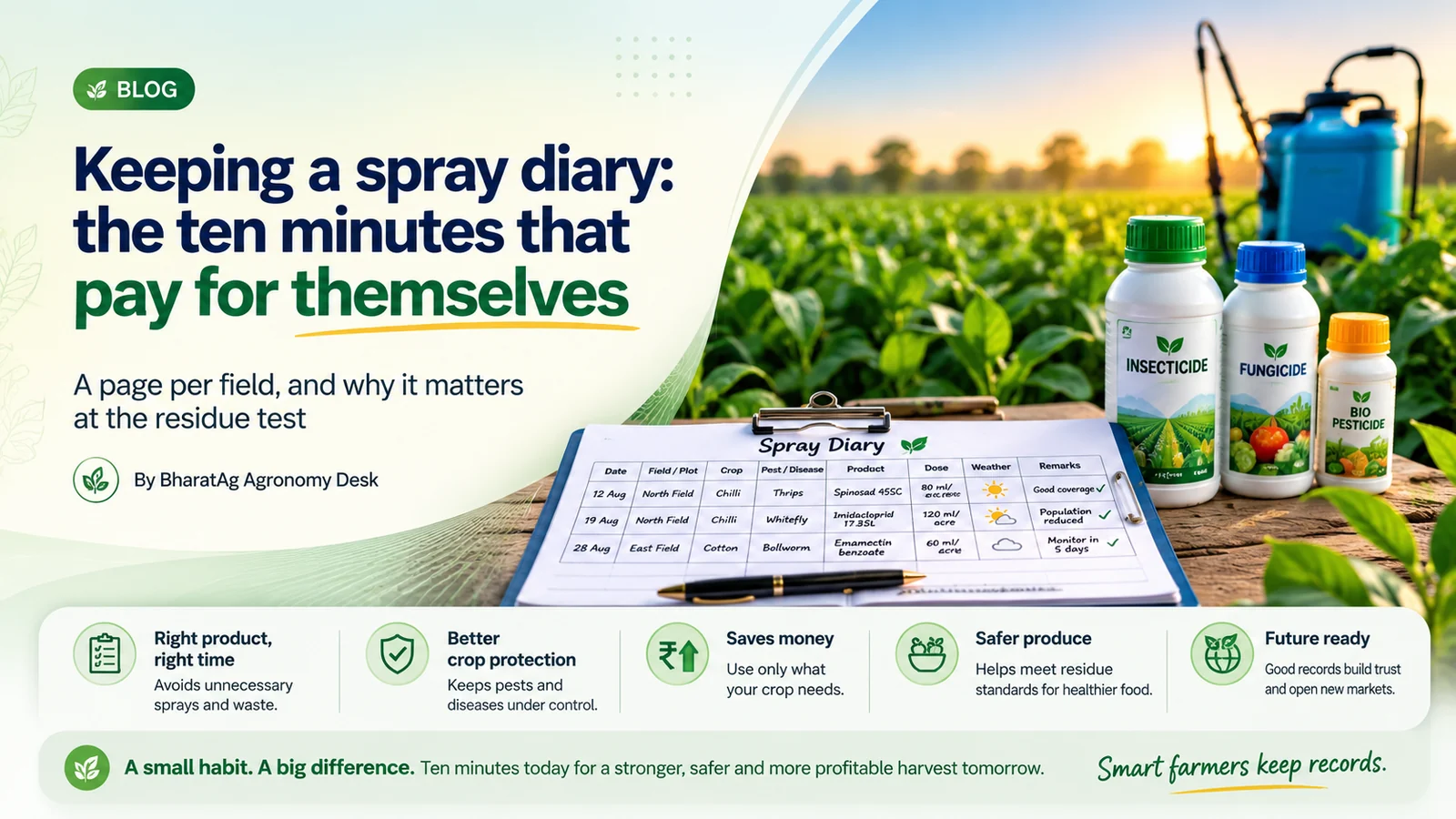
The question nobody can answer
What did you spray, and when?
Asked in July about a May application, the honest answer is usually a guess. That guess is then the basis for the next recommendation, and a wrong guess compounds.
What a diary needs
One page per field per season. Seven columns, written the same day:
- Date
- Crop stage (days after sowing, or the growth stage)
- Product and batch number
- Dose and water volume per acre
- What you were treating
- Weather — wind, temperature, whether rain followed
- What happened — checked five to seven days later
A notebook is fine. Photographs of the pack next to the bill work too, and take five seconds.
The four things it gives you back
Resistance management. You cannot rotate modes of action if you do not know what you used last time. Repeating the same group two or three sprays running is the fastest way to lose a chemistry, and it is almost always done by accident.
Waiting periods. With a date on paper, the pre-harvest interval is arithmetic. Without one, it is optimism. This is the difference that shows up in a residue test on an export consignment.
Honest evaluation. Column seven is the one that teaches you something. Five days after a spray, was the pest actually down? Most farmers believe every spray worked, because nobody checked.
A real conversation with the dealer. A farmer who arrives with a spray record gets a specific answer. A farmer who arrives with a description gets a general one.
For anyone selling to a buyer with standards
If you supply to a processor, an exporter or an organised retailer, the record is not optional. Increasingly they ask for it, and a field that cannot produce one gets paid the commodity price instead of the contract price.
Start with one field
Not every field, not this whole season. Take the field you argue about most, and keep the page. By next season you will keep them all, because the first page will have already answered a question that used to cost you a spray.
Record the batch number. It is the only way to trace a problem back to a pack.