Why most nutrition spend is guesswork
Ask ten farmers in a mandal what they apply and you will get roughly the same answer, because the plan was inherited from a neighbour who inherited it from his father. Meanwhile the soil has changed: continuous cropping, levelling, borewell water, and years of one-sided nitrogen.
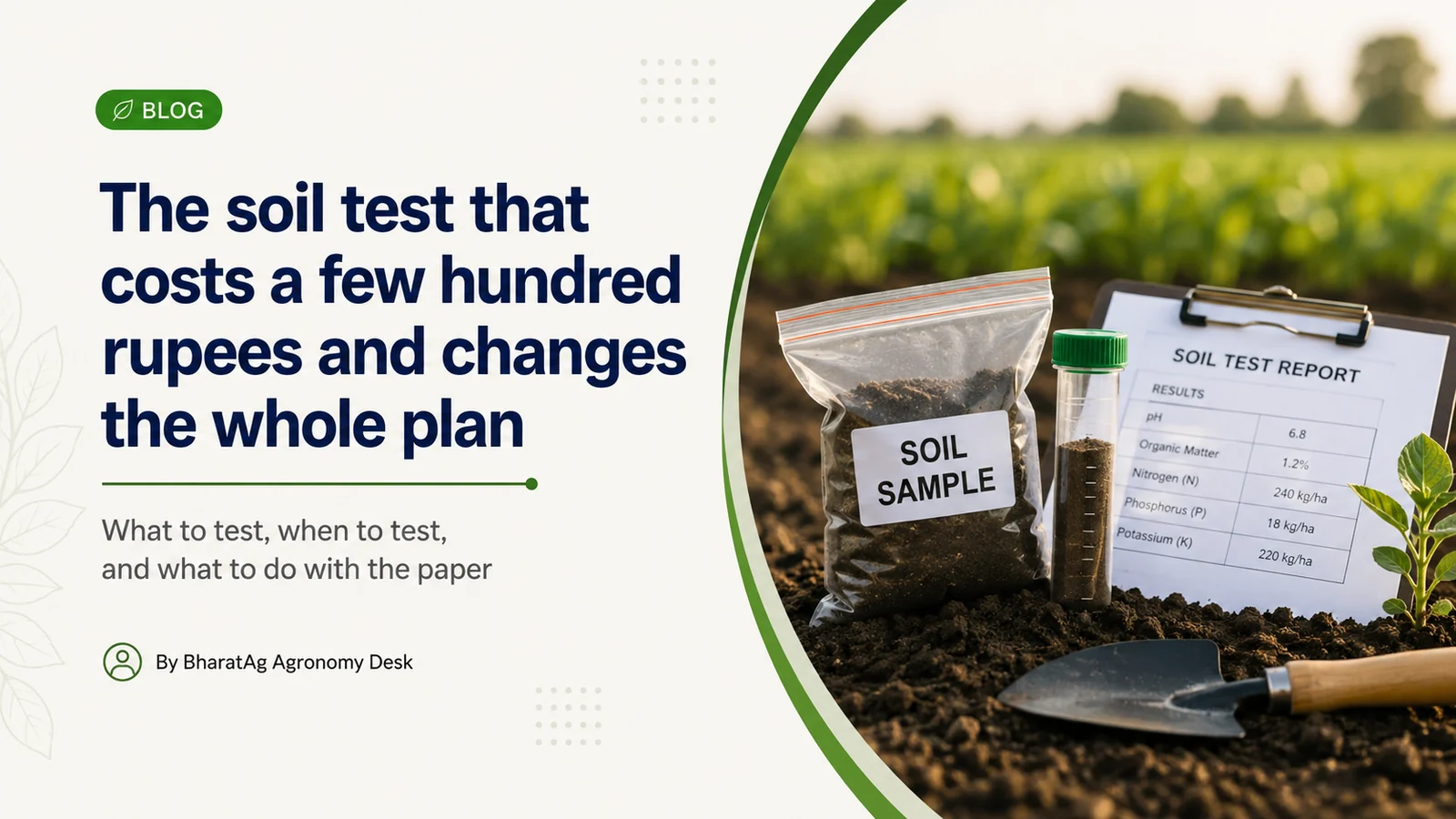
A soil test costs a few hundred rupees. A season of unnecessary DAP costs a great deal more.
What to ask for
At minimum: pH, electrical conductivity, organic carbon, and available N, P, K. Add zinc, boron, sulphur and iron — micronutrient deficiencies are widespread here and invisible until they cost yield.
Soil Health Card centres and KVKs do this. So do private labs. The number matters less than doing it at all.
How to take the sample properly
A bad sample is worse than no sample, because you will act on it.
- Walk the field in a zig-zag and take 10 to 15 spots, not one.
- Dig to 15 cm for field crops — a scrape of the surface tells you nothing about the root zone.
- Discard stones, roots and stubble.
- Mix all the spots together in a clean bucket, quarter it, and send about half a kilogram.
- Sample separately for a patch that behaves differently — the low corner that always yellows is its own field.
Sample after harvest and before the next fertiliser goes on. Sampling a week after applying DAP tells you about the DAP.
Reading the paper
Three numbers do most of the work:
pH. Above 8, zinc and iron lock up regardless of how much you apply to the soil — this is why khaira keeps coming back on levelled land. Below 6, phosphorus availability drops.
Organic carbon. Below 0.5% is common and is the real reason many fields respond poorly to everything. No spray fixes this; green manure, farmyard manure and residue do, slowly.
Sulphur. Oilseeds and pulses need it and it is missing more often than anyone expects, because the old fertilisers supplied it as a by-product and the new high-analysis ones do not.
Then change one thing
Do not rewrite the whole plan on the first report. Correct the single largest gap, keep the rest constant, and see what the crop does. That is how you learn what your soil actually responds to.
Bring your soil card to the counter. It is far more useful to us than a description of last year's crop.