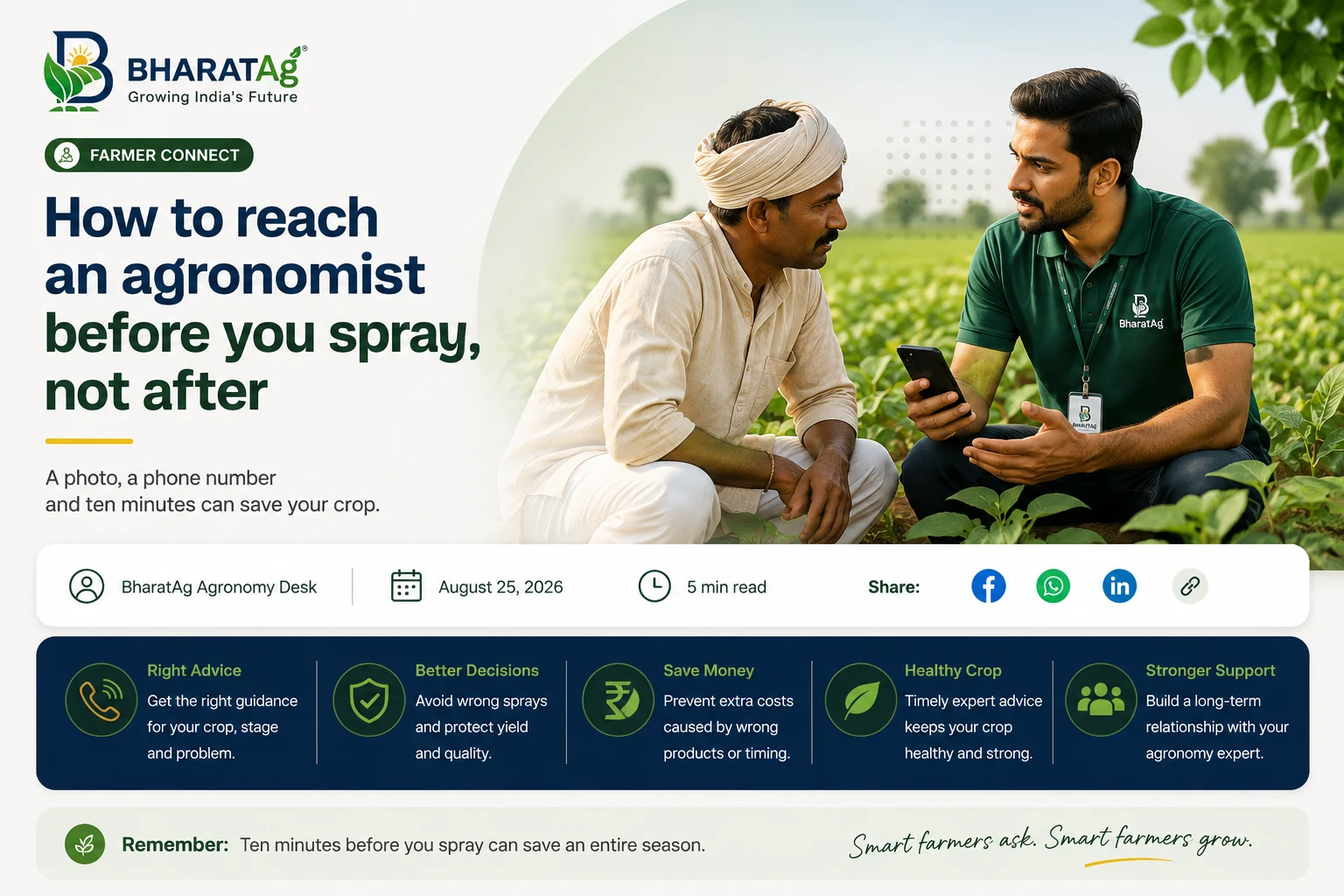
The call that comes too late
The question we get most often is a photograph of a dying crop with the message: I sprayed twice, nothing happened, what now? By that point the money is spent and the window has usually closed.
The same photograph, sent a week earlier, is a completely different conversation.
What to send
A useful field photo takes thirty seconds:
- One close-up of the damage, filling the frame — the leaf, the boll, the stem.
- One wide shot of the same plant, standing back a few feet, so we can see the whole plant and its neighbours.
- One of the field, showing whether the problem is in patches, along the border, or everywhere.
Then four lines of text:
- Crop and variety.
- Age of the crop, or the sowing date.
- What you have already sprayed, and when.
- Your village and district.
Why the last two matter most
The spray history tells us whether we are looking at a pest problem or a phytotoxicity problem. A leaf burn after a herbicide application looks a great deal like a disease to anyone who was not there.
The location tells us what is going around. If four farmers in the same mandal have sent the same photograph in a week, that is not a coincidence, and the advice changes.
Where to send it
The WhatsApp number is on every pack and on the contact page of this site. It reaches a person, in business hours, who will look at the photo. If it needs a field visit, we say so rather than guessing.
We do not charge for this. An accurate diagnosis is better for us too — a farmer who sprays the wrong product on our advice does not come back.
What we will not do over the phone
We will not recommend a product for a crop it is not registered on, however common the practice is locally. We will not suggest a dose above the label. And if the honest answer is that the damage has already happened and a spray now would be money wasted, that is what you will be told.
Read the label and the leaflet before any application. Approved crops, dose and waiting period are printed on the pack and they are what count.