The September 2026 edition of Agriculture Insights is out. The full report is attached as a PDF above — this page is the short version.
The one-line summary
Kharif 2026 is not a year with fewer crops. It is a year with a different crop mix in a weaker-water season. That distinction changes what September is for: protecting the crop already standing rather than adding to it.
Where the acreage went
Official area-sown data as on 21 August 2026, against the same date last year:
| Crop | 2026 | 2025 | Change |
|---|---|---|---|
| Rice | 405.10 L ha | 418.29 L ha | −13.19 |
| Pulses | 113.63 L ha | 112.14 L ha | +1.49 |
| Coarse cereals | 176.36 L ha | 179.81 L ha | −3.45 |
| Oilseeds | 188.37 L ha | 188.69 L ha | −0.32 |
| Cotton | 108.45 L ha | 108.73 L ha | −0.28 |
| Sugarcane | 58.44 L ha | 58.87 L ha | −0.43 |
Rice carries almost the whole drop. Pulses are the one gain. Cotton and oilseed acreage is close to flat — which means for those crops, September crop condition matters more than sowing did.
The monsoon signal
IMD's second-stage forecast placed June to September rainfall at 90% of LPA, ±4%, with a high probability of below normal. The more useful point for a grower is that the average hides the variation: the report separates peninsular India, east and central pockets, rainfed areas and irrigated areas, because each faces a different September question.
The one that matters on your own field is not the district figure. It is whether the root zone has enough moisture to carry the crop through its next critical stage.
The states
Karnataka is the urgent one — 101 taluks declared drought-affected, 89 severely, with a state rainfall deficit of around 30% to 26 August. September there is a water-budget month.
Telangana shows a real crop-mix shift: paddy area down about 11% year on year while tur is up about 15%. For a dealer, that means stocking to this year's crop mix rather than last year's sales mix.
Andhra Pradesh splits sharply between Godavari command areas and Rayalaseema rainfed pockets. The state average hides that split entirely.
Maharashtra matters by scale — soybean and cotton there move national numbers, and district divergence across Vidarbha, Marathwada and the Konkan is large.
MSP is not the price you get
The 2026–27 Kharif MSPs are in the report, with cotton medium staple at ₹8,267 per quintal, up ₹557. Sunflower rose most in rupee terms, at ₹8,343.
The report is careful about what those numbers mean, and it is worth repeating: MSP is a policy benchmark, not a universal daily market price. What you actually realise depends on variety and grade, moisture, deductions, local arrivals, procurement access and when you sell. A high MSP does not guarantee a high farm income.
What the report asks you to do in September
Not to spray more. To decide better:
- Look, check, decide, act, recheck. A calendar date is not a spray date.
- Scout before spraying — undersides of leaves, new growth, flowers, pods.
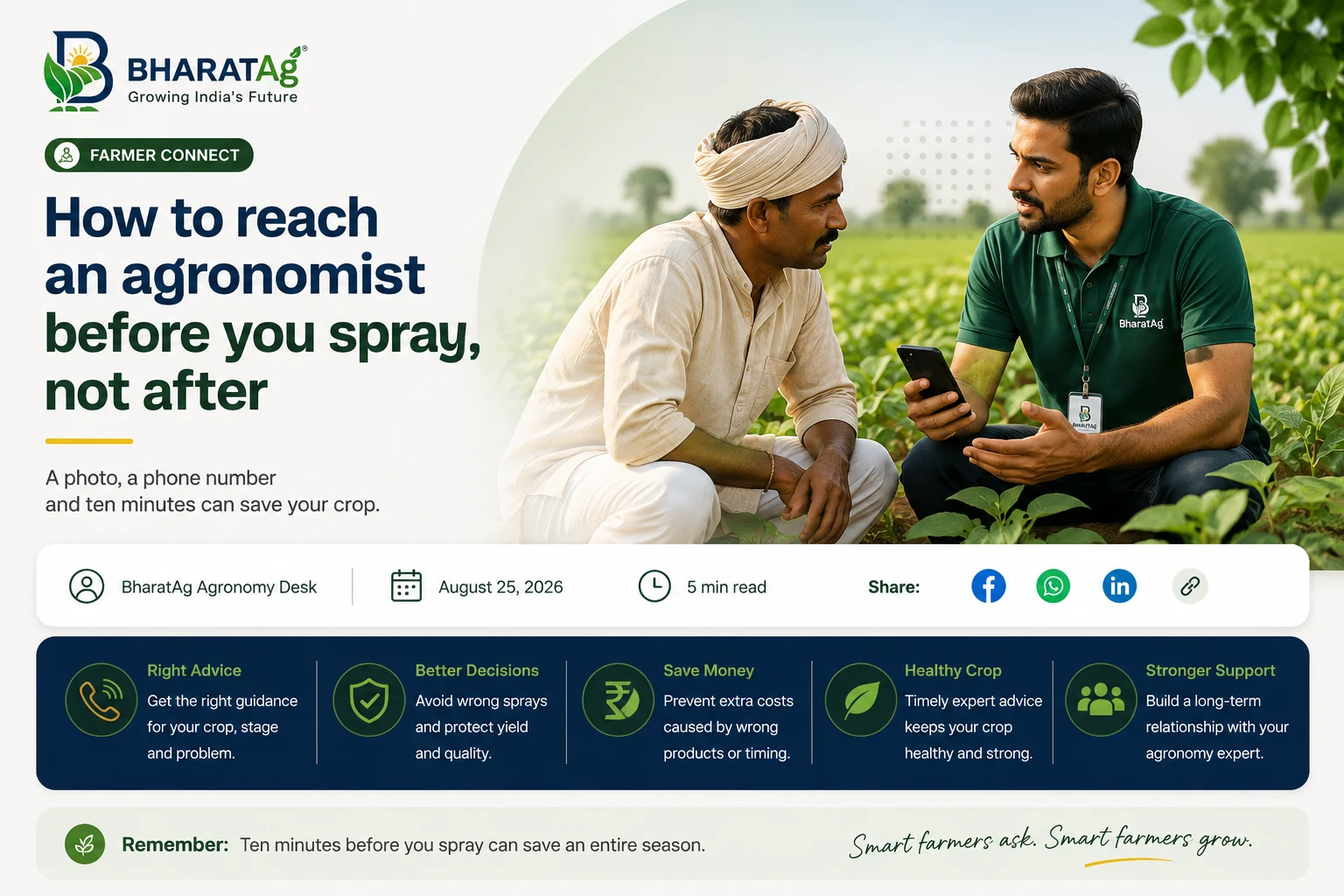
- Take three to five photographs before calling a dealer or agronomist: whole
plant, affected patch, close-up of the symptom, underside of the leaf, and the pest if you can see it.
- Record the pest incidence before buying anything.
- Start Rabi planning now — seed, soil testing, irrigation and cash flow.
There is a printable 30-day checklist in the report, one line per week.
The line worth keeping
Good farming is not more inputs. Good farming is better decisions.
Data cut-off is 31 August 2026. Sources include IMD, the Ministry of Agriculture and Farmers Welfare, PIB, AGMARKNET and state agriculture departments; the full source trail is in the PDF.
This report is for information and education. It is not a substitute for a qualified agronomist, your local weather advisory, or the approved product label. Never use an agricultural chemical outside its approved label, crop, dose, PPE or pre-harvest interval.