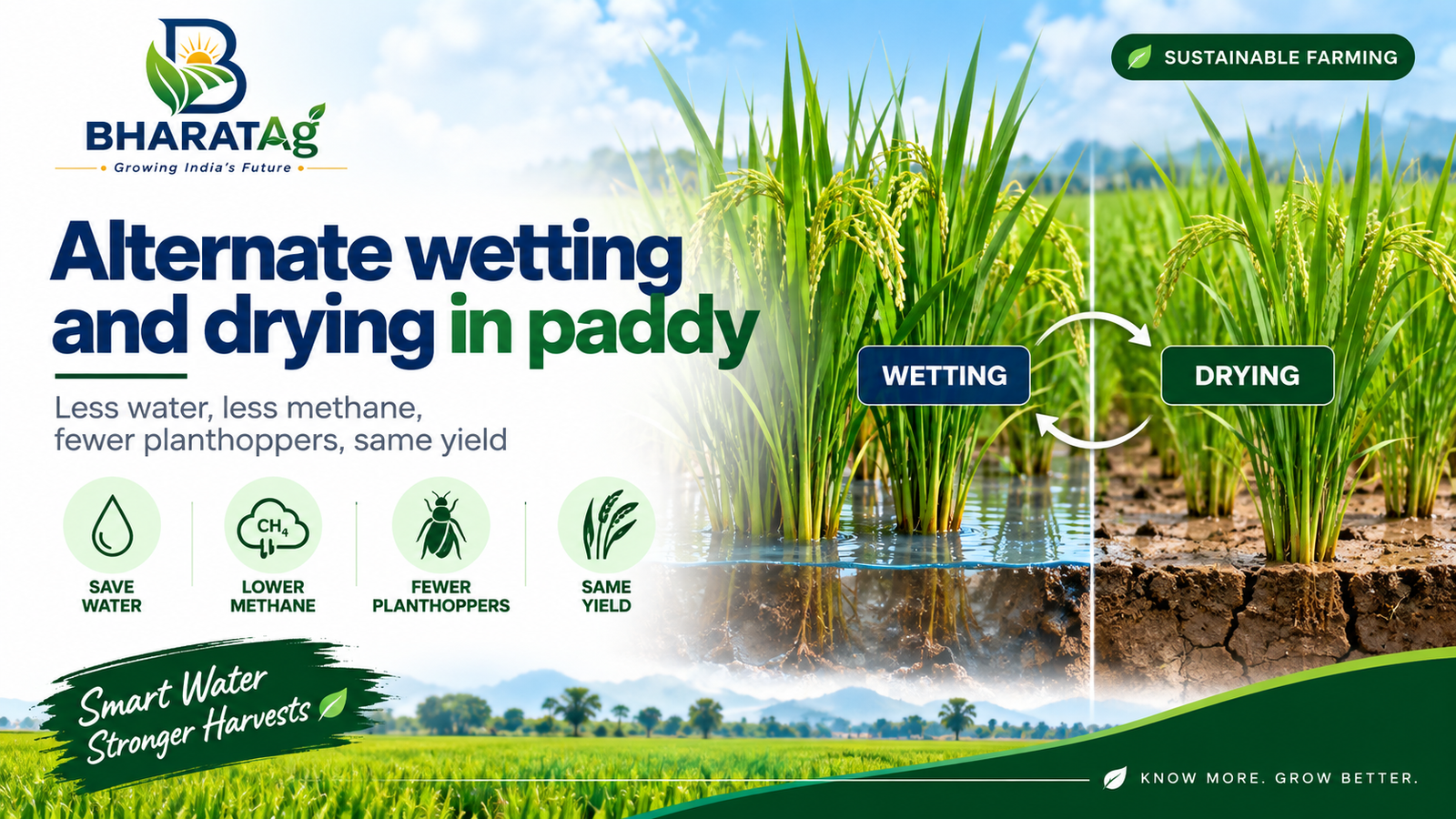
The habit
Rice is grown flooded because flooding suppresses weeds and because that is how it has always been done. But rice does not need standing water for most of its life — it needs saturated soil. The difference is a great deal of water.
How it works
Let the standing water disappear and the water level fall to about 15 cm below the soil surface, then irrigate back to 5 cm. Repeat.
Judge it with a field water tube: a perforated pipe about 30 cm long sunk 15 cm into the soil, with the inside cleared out so you can see the water level. When the water in the tube drops to the bottom, irrigate. It costs almost nothing to make.
What it gives
- Water saving of roughly 15 to 30% without yield loss, when done at this depth.
- Fewer brown planthoppers, because the humid microclimate at the plant base is disrupted.
- Less lodging, because roots grow deeper looking for water.
- Better nitrogen efficiency and less loss to denitrification.
- Substantially lower methane emissions, which matters if you supply anyone with sustainability requirements.
- Firmer ground at harvest.
The rules that keep it safe
Do not dry the field during flowering. That is the one stage where water stress costs yield directly. Keep 5 cm of standing water from about a week before flowering until a week after.
Do not go beyond 15 cm drawdown unless you are confident of the soil. Deeper drying stresses the crop and, on some soils, brings up salts.
Not on very light, leaky soils where the water disappears in hours — the technique needs soil that holds water for a few days.
Weeds get a chance. Standing water suppresses them; drying periods do not. Plan the weed programme accordingly rather than discovering it.
Where to start
One field, one season, beside a continuously flooded one. Measure the irrigations. On most farms the saving is obvious within a season and the yield difference is not.
Zinc and iron behave differently in aerobic soil. Watch for deficiency symptoms in fields that have always been kept flooded.