Blast
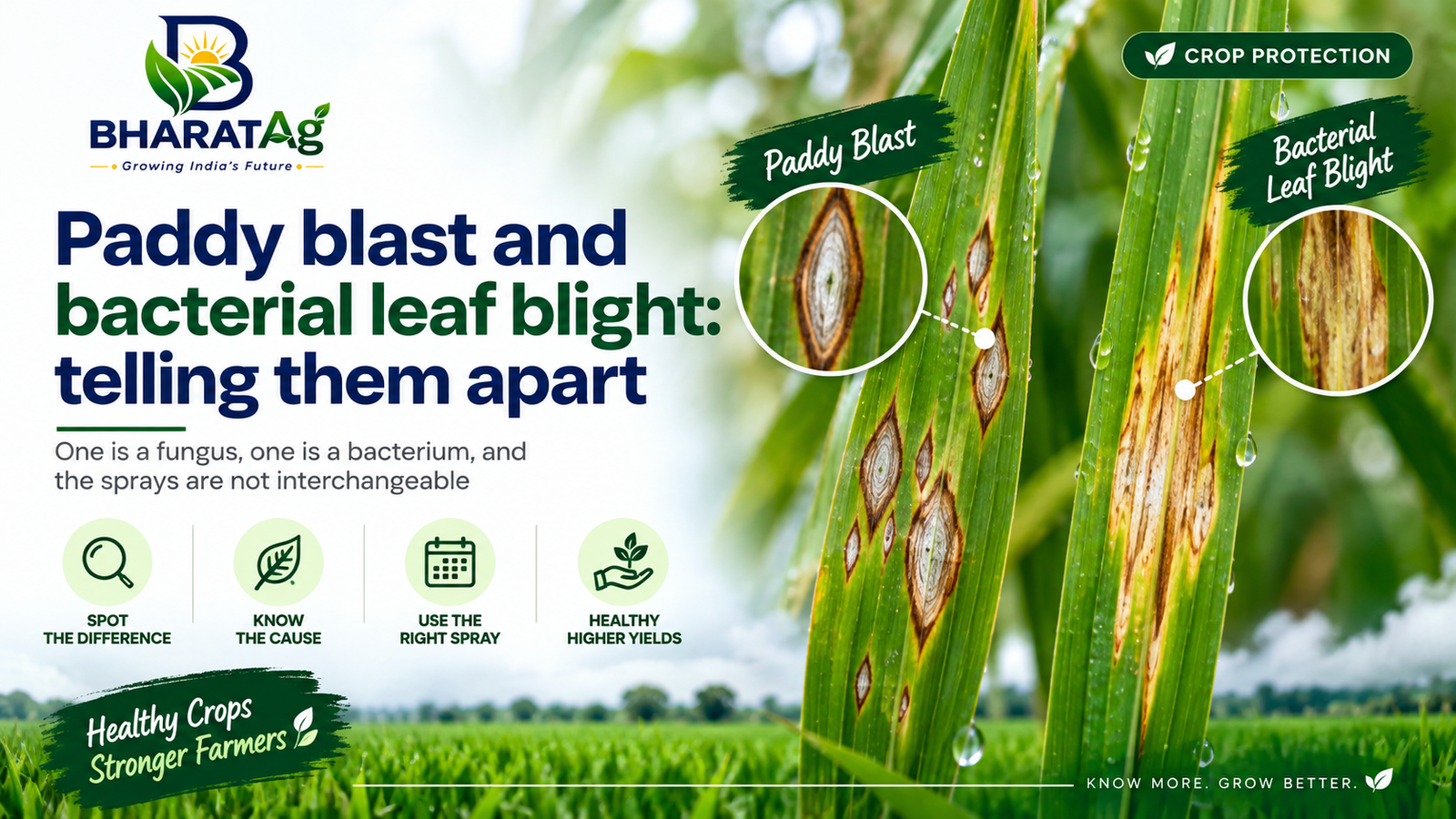
A fungus. Lesions are spindle or diamond shaped, grey in the centre with a brown margin. It attacks at three points:
- Leaf blast, in the vegetative stage.
- Collar blast, at the leaf collar.
- Neck blast, at the base of the panicle — the damaging one. A neck lesion strangles the panicle, the grain does not fill, and the panicle stands white and empty.
Favoured by high humidity, prolonged leaf wetness, cool nights, and above all excess nitrogen.
Management: a resistant variety, split nitrogen rather than heavy doses, adequate potassium and silicon, and a protectant application at booting to protect the neck — which is the spray that pays. Rotate the FRAC group.
Bacterial leaf blight
A bacterium. Lesions begin at the leaf tip or margin as water-soaked streaks that turn yellow then straw-coloured, with a wavy edge, and run down the length of the leaf. In severe early infection whole seedlings wilt — the kresek phase.
Favoured by wounding, wind-driven rain, flooding and, again, excess nitrogen.
Fungicides do not control it. Management is:
- Resistant varieties, the strongest lever.
- Avoid excess nitrogen.
- Drain the field where possible; the bacterium moves in water.
- Avoid clipping seedling tips in an infected nursery, which spreads it.
- Destroy stubble and volunteer plants that carry it over.
The mistake that costs
Treating blight with a blast fungicide. It fails, the product gets blamed, and the crop is lost anyway. The lesion shape and starting point separate them in seconds: spindles in the middle of the leaf means blast; streaks from the tip and margin means blight.
What both have in common
Both are worse on a lush, over-fertilised, dense crop. Splitting the nitrogen, holding to the recommended rate and not crowding the plants reduces both more reliably than anything applied afterwards.
Silicon strengthens the cell walls and measurably reduces blast penetration; rice is a silicon accumulator and many intensively cropped paddy soils are depleted of it.
Read the label and the leaflet on the pack before use. The approved crops, dose and waiting period printed there are what count.